


MoneyPilot : Class Action
4.6211.00 Reviews
App Specs
- Version
- 1.0.55
- Updated On
- License
- Free
- Downloads
- 50,000+
- Developer
- Bloom Processing
- Categories
- Finance
- Platform
- Android
Screenshots


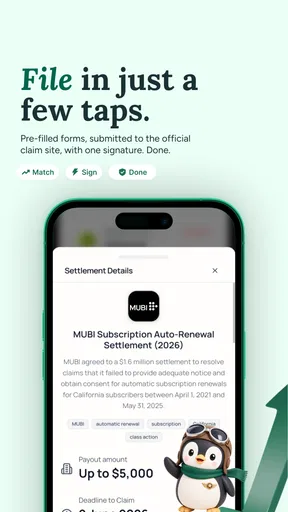
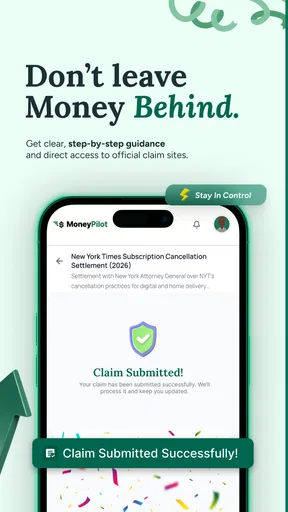
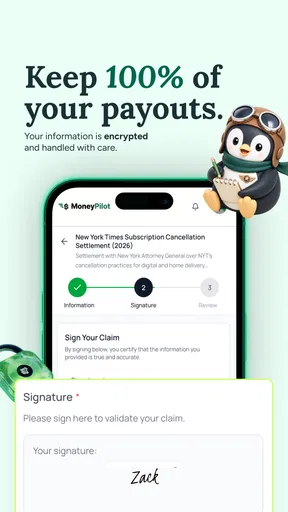

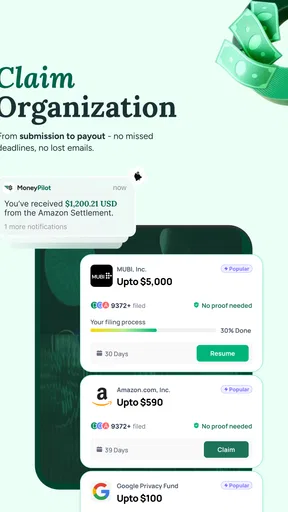
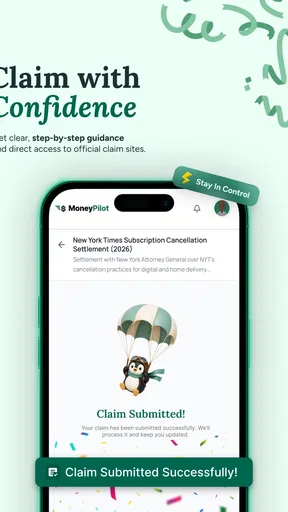
 Analysis by AppCompare
I approached MoneyPilot: Class Action as a practical finance app rather than something I would open for entertainment. Its purpose is straightforward: help me look for possible claims, keep track of them, and submit payout claims when appropriate. That narrow focus is also its main appeal. Instead of trying to become a full budgeting suite, it concentrates on money that may be available through settlements and claims.
In the first few days, the app feels useful because it turns an easy-to-forget task into something visible. I can imagine checking it after hearing about a settlement, reviewing an item that may apply to me, and deciding whether it is worth continuing. The experience is especially attractive to people who do not regularly follow consumer settlements but still want a simple way to notice opportunities. MoneyPilot is free to download, carries an Everyone age rating, and comes from Bloom Processing, so the initial barrier to trying it is low.
How MoneyPilot fits into real financial habits
I find MoneyPilot most useful when it slots into a routine I already have, rather than becoming another app I feel obliged to check every day. In this section, I look at how its claims-focused purpose compares with ordinary money habits and where a small, repeatable check can help. The next question is whether that workflow stays comfortable and clear across different ways of using a phone.
The first week: useful because it creates a starting point
The strongest early benefit is organization. Claims are easy to lose among emails, browser tabs, social posts, and legal notices. A dedicated app gives that information a place to live. I found the idea most helpful when treating it as a quick review tool rather than expecting it to produce instant money. The sensible routine is to open it, inspect opportunities carefully, and only proceed with claims that genuinely match my circumstances.
That distinction matters. A claim is not the same thing as guaranteed payment, and an app that helps locate or submit claims cannot change the eligibility rules of a settlement. I would still read the requirements, check the relevant dates or purchase conditions, and keep any supporting information before submitting. MoneyPilot can reduce the searching and remembering, but the final responsibility for an accurate claim remains with me.
A realistic use case would be someone who notices a notice about a consumer settlement but does not have time to investigate it immediately. Rather than ignoring it, they can use the app as a holding point, examine the claim later, and decide whether the effort makes sense. That small workflow is more valuable than it sounds because forgotten deadlines are often the real obstacle, not a lack of interest.
My first practical tip is to avoid treating every listing as an automatic opportunity. I would compare the claim requirements with what I actually remember buying or using. If the connection is weak, submitting simply because the process looks easy may create unnecessary clutter and disappointment. The app works best when it supports a short verification habit, not when it encourages blind tapping.
Worth Reading Before You Choose

EA SPORTS FC Mobile 26 Is a Bigger Football Game, but It Takes Time

Flipboard Shows What News Apps Must Do Beyond the Feed

Switching to Android Auto Means Rethinking Your Driving Routine

Google Calendar Makes a Crowded Week Easier to Manage

Ludo King Makes the Most of the Minutes Between Plans

Baby Panda World Brings Quick Play to Modern Phones, but Its Game Library Feels Busy
What makes the early experience different from ordinary finance apps
Compared with a budgeting app, MoneyPilot is much narrower. It does not occupy the same role as a tool for tracking spending, planning bills, or monitoring account balances. That is a limitation if I want one application to manage my entire financial life, but it is also a relief for someone who only wants to investigate settlement-related money without setting up categories, accounts, or recurring budgets.
Compared with searching the web manually, a dedicated claims finder can be more convenient because the task has a clear destination. Search results often mix news, advertisements, old announcements, and general legal explanations. A claims-focused workflow should help me move from discovery to review and submission with less wandering. The trade-off is that I need to trust myself to inspect the details instead of assuming that a clean interface has already done all the checking for me.
The app has a 4.6 average from around 1.9 thousand ratings, which suggests that many early users find the concept worthwhile. I would not use that figure as a substitute for my own judgment, though. Claims apps are highly dependent on whether the available opportunities are relevant to a particular person. Someone who rarely qualifies for settlements may have a very different experience from someone who regularly notices matching notices.
Month-to-month value: does it become a habit?
The long-term question is not whether finding a claim feels interesting once. It is whether the app continues to save enough time to deserve a place on my phone. For MoneyPilot, recurring value depends on a light maintenance routine. I would check it occasionally, review anything new, and remove the mental burden of remembering where a possible claim was found. That can be worthwhile, but it is unlikely to justify constant daily use.
I see this as a periodic finance check, similar to reviewing an insurance document or checking for an overlooked refund. Opening the app every day would probably be excessive unless I had a specific reason. A monthly or occasional visit makes more sense because the value comes from catching relevant opportunities over time, not from continuous interaction.
A useful approach is to pair the app with an existing routine, such as reviewing subscriptions or checking household expenses. That creates a natural reminder without turning MoneyPilot into another source of notifications and screen time. The best habit is deliberately small: open it, investigate genuinely relevant claims, save the information needed for a submission, and leave.
There is also a practical trade-off around effort. A possible payout may sound attractive, but the claim can still require careful reading and accurate answers. If the process asks for information I cannot verify, I would rather stop than guess. The app can make discovery easier, yet it cannot make every settlement worthwhile. For a small expected benefit, even a short form may not justify the time; for a claim that clearly matches my experience, the same form may be reasonable.
MoneyPilot has reached over fifty thousand installs, enough to show that the idea has found an audience beyond a handful of early testers. Its current version is 1.0.55, and the app supports Android seven point zero and later. That compatibility makes it accessible to people using older Android devices, although I would still keep the application updated when updates are available so the experience remains dependable.
Maintenance burden: what I would need to do
The maintenance burden is fairly low in concept, but it is not zero. I would need to check entries rather than letting them become a pile of unopened possibilities. I would also keep track of claims I have already submitted, especially if I use the app for more than one opportunity. A simple personal note with the claim name, submission date, and any confirmation information would make the process easier to audit later.
That is one of the less obvious ways to use the app well: separate discovery from record-keeping. I would use MoneyPilot to find and submit a relevant claim, then keep my own concise record outside the app. This avoids relying on memory and makes it easier to recognize duplicate opportunities. It also gives me a clear answer if I later wonder whether I already completed a form.
I would not install it and forget about it completely. A claims finder only helps if I return often enough to notice something relevant, but checking too frequently can make the app feel empty or repetitive. The right balance is occasional review. Users who want a constantly active financial dashboard may find this narrow rhythm unsatisfying, while users who prefer low-maintenance tools may appreciate it.
MoneyPilot is free, but it includes in-app purchases ranging from a few dollars to amounts approaching one hundred dollars per item. That changes how I would evaluate the app. I would begin with the free experience and understand exactly what is included before spending anything. A purchase should have a clear, understandable purpose and should never be treated as a requirement for making a careful claim decision.
This is also where I would be more cautious than with a normal free utility. The possible value of a settlement is uncertain, so paying for access or extra functionality needs a stronger justification than paying for a tool with a predictable benefit. I would compare any cost with the likely value of the claim, read the purchase description carefully, and avoid spending simply because an opportunity feels urgent.
Where fatigue can set in
The biggest source of fatigue is relevance. If the app repeatedly shows claims that do not apply to me, the initial curiosity will fade quickly. A claims service cannot manufacture eligibility, and the usefulness of each visit depends on finding something that matches my purchases, location, usage, or personal history. When several checks produce nothing actionable, the app can start to feel like another inbox.
There is a second kind of fatigue: uncertainty. Settlement language can be more complicated than ordinary shopping information. I may need to determine whether a product, time period, or type of purchase fits the rules. Even a well-organized app cannot remove that judgment entirely. I would be wary of any workflow that makes a claim feel so effortless that I stop reading the conditions.
Submission itself can also create friction. Accurate forms require patience, and I may need to search old receipts, emails, account records, or purchase histories. That is not necessarily a flaw in MoneyPilot; it is part of making a legitimate claim. Still, users should know that the app is not a magic shortcut to effortless payouts. Its real advantage is helping me discover and organize the opportunity before I do the final verification work.
Another limitation is that this is not the right replacement for official settlement information. If a claim involves a significant amount of money, unusual eligibility rules, or sensitive personal circumstances, I would read the official notice and consider whether professional advice is appropriate. MoneyPilot can be a convenient starting point, but I would not let convenience override the original terms.
The app may also be a poor fit for people who already have a reliable system for tracking settlements. Someone who follows consumer-protection news, keeps detailed records, and checks official sources may gain little from adding another layer. In that case, a browser bookmark system or a general notes app could be simpler. MoneyPilot earns its space mainly for people who want a focused place to discover and manage claims without building that system themselves.
Who will get the most from it?
I think the best audience is the occasional claimant: someone who wants to look for possible settlement money but does not want to spend time monitoring legal news or maintaining spreadsheets. It is also useful for people who tend to postpone administrative tasks. Having a dedicated finance app can turn “I should check that later” into a repeatable action.
It can help households as well. One person could review the app while another checks old purchase records, reducing the chance that a relevant claim is forgotten. I would still coordinate clearly to prevent duplicate submissions, since a shared household may have several people who encounter the same opportunity.
I would skip it if I expect guaranteed returns, instant payouts, or a complete personal-finance manager. The app’s purpose is discovery and claim handling, not budgeting or investment planning. I would also skip it if I dislike reviewing legal conditions or if I am unwilling to keep a basic record of what I submit. In those cases, the extra app may create more frustration than value.
The age rating of Everyone makes the app broadly approachable, but that should not be confused with every claim being suitable for every person. Eligibility still depends on the conditions of each opportunity. I would use the age rating as an accessibility signal, not as a reason to assume that every listing applies to me.
My long-term verdict
After the novelty fades, MoneyPilot: Class Action stands or falls on whether it saves me enough searching and remembering to justify occasional maintenance. I think it can. Its focused role is clear, and that focus is more useful than a crowded finance app when my specific goal is to find and track claims. The strongest experience comes from using it as a periodic checkpoint, then applying my own judgment before submitting anything.
I would not keep it on my phone for constant daily interaction. That is not a criticism so much as an honest description of the category. The app’s recurring value is occasional and practical. It earns space when I want a dedicated claims workflow, especially if I otherwise forget notices or lose track of forms. It becomes less compelling when relevant opportunities are rare or when I already have a dependable manual system.
Bloom Processing has made a useful specialist tool rather than an all-purpose money manager. The free entry point makes trying it reasonable, while the in-app purchase range means I would approach paid options carefully and judge them against a specific need. With over fifty thousand installs and a 4.6 average, it has enough early traction to be worth considering, but the real test for me is whether each return visit produces a clear next step.
My recommendation is measured: try it if you want a simpler way to look for possible settlements, but build a disciplined habit around it. Check occasionally, read eligibility requirements, keep your own submission notes, and never assume that a possible claim equals guaranteed money. Used that way, MoneyPilot: Class Action can be a useful low-frequency finance companion. Used as a promise of effortless payouts, it will probably disappoint.
Pros
- Simple interface makes class action information easy to browse.
- Helps users discover settlements they may not know about.
- Claim deadlines and eligibility details are clearly presented.
- Useful notifications can help users avoid missing important updates.
- Free to download and convenient for checking cases on the go.
Cons
- Available settlements may vary depending on your location.
- Not every listed case will be eligible for every user.
- Payout amounts and approval times can be uncertain.
- Some features may require sharing personal claim information.
- The app does not guarantee acceptance or payment for submitted claims.
FAQs for MoneyPilot : Class Action
What is MoneyPilot: Class Action, and what does the app do?
MoneyPilot: Class Action is designed to help users discover and track potential class action settlements and claims they may qualify for. It can provide information about available cases, eligibility requirements, important deadlines, and possible compensation. Before relying on any listing, review the official settlement website and court-approved notices, because the app is an information and convenience tool rather than a law firm or legal representative.
Is MoneyPilot: Class Action free to download and use?
The app may be available to download without an upfront charge, but users should still check its current store listing for details about subscriptions, premium features, advertising, or other in-app costs. Some services may offer optional paid tools or enhanced access. Always read the pricing information and cancellation terms before starting a trial or entering payment details, particularly if the app requests recurring billing.
Can MoneyPilot guarantee that I will receive money from a class action settlement?
No application can guarantee that a user will receive compensation. Eligibility depends on the specific settlement rules, the information submitted, claim deadlines, and the administrator’s review. MoneyPilot may help identify possible opportunities, but it does not decide whether a claim is valid or how much it is worth. Submit claims only through verified official channels and keep copies of your confirmation and supporting documents.
What personal information may be required when using MoneyPilot: Class Action?
Depending on the features you use, the app may request information such as your name, email address, location, or details needed to match you with possible settlements. A particular claim may also require purchase records, account information, or other proof. Before providing sensitive data, read the app’s privacy policy, check its permissions, and confirm that any claim form is connected to the legitimate settlement administrator.
Is MoneyPilot: Class Action available for both Android and iPhone?
Availability can vary by country, device, and operating-system version, so users should verify the official Google Play or Apple App Store listing before downloading. Check the developer name, recent updates, ratings, permissions, and supported versions to avoid unofficial copies. If the app is unavailable in your region, settlement information may still be accessible through the official case website or court-approved notice.


